Friday, August 15, 2014

At'mavi vs Koldrogan: The 3000 Year War

At'mavi vs. Koldrogan: The 3000 Year War

One of the biggest central plots in the book series will follow the ending of a wide scale war that has been going on for over three thousand years. In this article, I will be lining out the facts as of the in-world year of 300 6gc and provide teasers for what is to come in the books that follow this story.

Warring Parties

This war is waged between two parties: The At'mavan Empire and the banded war tribes of Koldrogan. Koldrogan is divided into two parts by At'mavan territory and mountains, east and west. Occasionally Torlynn, across the waters to the east, or Jen'wendas Isle, to the west of the continent, become involved, but they mind their own for the most part. 

File:Golboreh Habitation Map.png

How the War Began

In the ancient days, when the second era civilizations had crumbled, a large void was left on the continent of At'mavi where the Dega empire had been. What few humans survived the cataclysmic destruction of Dega were misplaced and reverted to tribalism to survive. As generations passed, the humans began to spread, and the Golboren trolls, who were driven into hiding by the people of Dega, began to flourish again. 

TempDazumas01
Things were peaceful between them for hundreds of years, but humans, adaptive as they are, began to develop civilization once more, and as they built farms and villages and cities, the trolls became wary and kept their distance from  the humans, returning to the forests and mountains. Over the next few centuries, they made themselves so scarce that most of the At'mavan humans began to think that the trolls were no more than myths.

In the third great cycle (early in the 3000s), under the reign and command of emperor Khadmar Izhodas, the At'mavan people began to send settlers into the southern heartlands of the continent, driven by a need for its rich timbers, as they had depleted their own forests. A scouting party sent back a report of a strange tree in the central southern woods, in the Painted Forest region, with a description that enticed shamans to investigate. An investigation party was formed comprising of soldiers and shamans, and the mission commenced.
This tree was called the Tantagruhk by the native Golboren trolls, and it held a special place in their hearts. All tribes throughout the region, and occasionally pilgrims from others, came to this tree to give prayer and offering to this unique, ancient being. The tree was a living fossil, growing from the large base of an even more ancient, dead tree that had long turned to stone. Cracks in the petrified base revealed beautiful opal.

The Golboren treated this as a magnet for sacred spiritual energy. The At'mavan party, as they approached the Tantagruhk, found the native trolls gathered around in celebration of the landmark. Curious and afraid, the trolls tried to communicate with the At'mavan people, but when they would not leave their weapons at the perimeter, the trolls became hostile and loud, trying to push them away from the landmark. 

The soldiers reacted by slaying the few that tried to push them back, hoping to frighten the other trolls into retreating. The action had the opposite effect, and all of them came to the defense of the slain, throwing themselves at the soldiers now with every intent of killing them. The soldiers killed every one of them, suffering nothing but light wounds, and their guarded shamans began prospecting the Tantagruhk. 

But, watching from the treeline, was a survivor. A young man whose name would some day be heard the world over: Koldroga. The At'mavans caught one glimpse of him standing above them, watching with calm acceptance, before he turned and ran into the forest. He was not pursued, and after studying the Tantagruhk,  the At'mavans sent word that the area was to be settled.

Koldroga had other plans. After witnessing the slaughter, he ran to the nearest tribe and alerted them to the situation. They took up arms and gave him a Lors, which is very comparable to the extinct Irish Elk of the Pleistocene age of Earth, so that he could ride and alert the other tribes. On the back of this Lors, he covered all of the trollish territory, spreading the story and preparing them for what may come. 

He ended his journey where he began. Many local tribes had banded together, awaiting his command. In the time it had taken him to unify his people, the At'mavans had constructed a settlement around the Tantagruhk, but they had not expected retaliation of the size Koldroga had rallied. A battle was waged, and the At'mavans were decimated, the trolls only allowing the young and noncombatants to live and return to their people. The trolls reclaimed the Tantagruhk,  marking the true beginning of the war.


The Rise of a People

During his reign as the first war king of the Golboren, he lead his people to many victories and secured vast tracts of land. For the first time, the trolls had a unified cause. Over the next decades, they grew a strong cultural identity and sense of purpose. The many tribes were working together and successfully eliminating invaders within their territory. Lines were being drawn and mapped, forming what would some day become their country.

Although the trolls could not hope to see At'mavi's cities conquered without more resources and more warriors, their ability to hold on to what they perceived as their territory was unmatchable. The best At'mavan scouting parties could not compete with the trolls' advanced guerrilla tactics and knowledge of the land. The consistent defeats wore away at emperor Khadmar's patience, and soon, he appointed a new general, Hespar, whose sole mission was to see Koldroga killed.
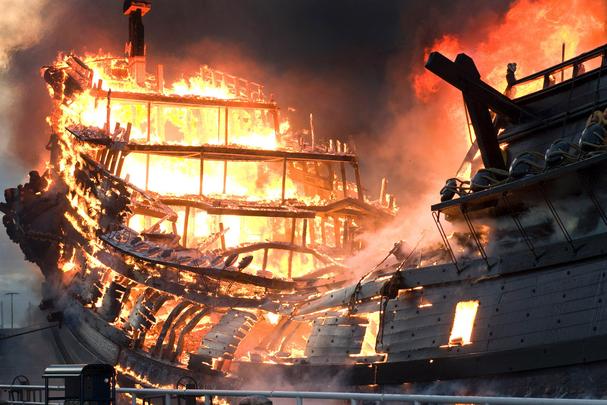
Koldroga's and Hespar's victories from this time period are countless and still recounted and sung thousands of years after they occurred. One of the most famous victory stories told by the trolls is of the time At'mavi sent a war ship down the Heskegi River, hoping to deliver a regiment of warriors behind enemy lines to ambush the trolls. Koldroga and his trusted warriors leapt onto the ship as it passed through a narrow bend in the river, climbing its sides and setting it on fire. The startled At'mavans were slain, if not by the fire, then by the river or the trolls, who awaited them on the shoreline.


Birth of a Martyr, Dawn of a Country

Koldroga converged with western forces, and with their combined might, they were able to wrest control of the Degahar region from the At'mavan troops. Unbeknownst to Koldroga, he had played right into the hand of Hespar, who had brought the bulk of his war force west. The opportunity was too great to pass up, and he readied for an ambush. Koldroga separated from those stationed in the west, taking a smaller band with him to allow for quick travel back to the east, where pressure had mounted.

In a low basin, where the forests broke in the north to reveal open sky and grassland steppes, the At'mavan forces came down upon them. They were overwhelmed immediately, pushed back from the road and into the treeline. Hespar watched from an escarpment to the southeast of the battle, and as Koldroga cried for his people to retreat, he drew his bow and honed in on him. 

With a deep, steadying breath, he fired the first arrow. Koldroga, just as he turned for the forest, took the arrow deep in the right shoulder. Hespar, utilizing his martial technique and discipline, swiftly had a second and a third shot fired. The second shot struck his target in the middle of the back, and the last one caught Koldroga in the back of the head. Miraculously, the troll king did not stop running.

When the battle was done, Hespar had his men remove the tip of the tail of every troll for accurate recording of the dead, and demanded that he be alerted as soon as Koldroga's body was found. To the shock of Hespar and his men, the body was never found. A blood trail was picked up but, after a length, the blood abruptly ended and no more leaves were disturbed. Rumors spread amongst the people of both sides of the war that Koldroga had simply melted into the forest, becoming one with his land.

In honor of his greatest sacrifice, giving his spirit and body to the forest so that he may always guide them, the Golboren trolls took heart in his disappearance and declared themselves an independant country by the name of Koldrogan, meaning "Spirit of Koldroga" in the suffix-based Golboren language. A new leader was chosen, and a system fell into place so that the country would never be without one. 


After Koldroga's Fall

Hespar went on to commit many victories in the name of At'mavi, despite never finding proof of his greatest  kill. His reign was finally ended within two decades later, killed by a troll on the battlefield that used Hespar's long hair to yank him into a vulnerable state. From that moment to present-day At'mavi, warriors in the At'mavan military keep their hair cut in honor of their first great war hero.

The war was destined to carry on for three great cycles, equating to three thousand years. At times, the combat was fierce and hellish, but at times the conflict would simmer down to only the occasional skirmish for a handful of decades. Neither side was ever able to mount a strong enough force to take each other down, and what began as a turf war, over time, morphed into a war fueled by hate of the other race.
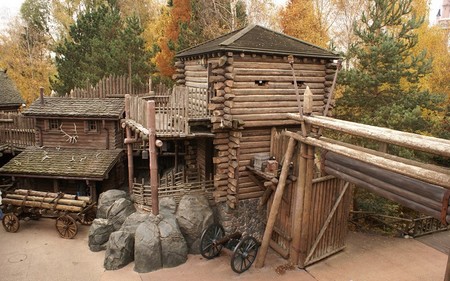
The Tantagruhk became the proud symbol of Koldrogan, and the Golboren people built a strong, vast fortress around the holy site. It became their capital, where all war kings and war queens would hold serious meetings and conduct official business. A second base of operations was set up in the Degahar region to handle immediate concerns in the west.

The At'mavan people, in the fifth great cycle, managed to wrest the Heskegi region from Golboren control, separating the east from the west by a thin line of territory. 

The At'mavi-Koldrogan Shaman's Symposium was founded to allow pacifist shamans to gather and discuss issues pertinent to their profession, to trade medicines, and to allow masters to adopt new apprentices. The event is held annually and is protected by forces on both sides of the conflict. Political discussions are banned for fear of violence.

The councils of the World Senate have begun to turn their eye to the Golboren people, debating on whether or not they will permit an ambassador from Koldrogan to join their ranks.

Where the Story Begins

Antegga Portrait 2012The story will follow a young warrior by the name of Antegga Koldroskaro, who is cast out of his tribe by his mother after the accidental murder of his father, the war chief, during a coming of age duel. With only his cousins and sister to support him, he must learn to survive in the harsh wilds of Koldrogan as he comes to terms with the consequences of his error and learn how life functions outside of home.

 His journey begins meager, with only the clothes on his back and his father's sword, and with three companions at his side, but his heart is not snuffed out by the conditions. Instead, he blossoms, building a following of his own as he sets his sights upon the title of War King of Koldrogan. 

Over the course of his story, the audience will come to learn the Golboren people's culture and lifestyles from within the system itself and see firsthand how the At'mavan people are, in fact, not the only bad guys anymore. The many factions of Koldrogan will be revealed, from the Kamunagi (warriors of the night), to the shamans, the chrut (nomadic silent druids of the deep woods), sorcerers, witches and warlocks, political intrigue, and how the entire war has become nothing but a display of heated racism.

This will be one of the most action-packed, richly detailed series in the entire franchise, and one of the first chain of books to get started chronologically, so I hope that I've cultivated some interest in this story and these characters within you. I hope you look forward to it at least a fraction of how much I do. (I know about a lot of events that you can't possibly know about, so I don't expect the kind of overzealous enthusiasm that I have.)

Anyway, that's all for this summary for the moment. I will run follow-up posts on any further details as  I  feel they are ready to go live. 

Until next time,
Matthew D. Hammond
~2014~


Friday, August 1, 2014

The Three Eras of Novan-Gan

    In the realm of Drumlore, the planet, Novan-Gan, has seen three great eras of civilization. Two of them had risen to an elite, world dominating status before crises struck them and they were (almost) entirely annihilated. The book series and short stories will all take place in the third of these eras. Here, let me break it down:

The Third Era

     The third wave of civilizations to grow on the face of Novan-Gan. Civilization has not reached its peak; technology is comparable in most places to the late BCs of Earth and countries still haven't expanded to their maximum capacities. There are still many places on the world map that have not been explored and documented, and arts of philosophy and logic have just been embraced by the masses. It's an era full of mystery, growth, progression, and enlightenment.

The Second Era


Throughout the series, many ruins and relics are encountered from ancient civilizations. These are the ruins and relics of the second era. At the peak of this era, there were three countries: Dega, Cal Dhima, and Jimhalan. These three massive countries had amazing architectural sophistication, and where their cities were at their densest, sprawling ruins still remain after tens of thousands of  years.


    Little is known about the people who once inhabited these vast cities or what lead to their demise. There are reoccurring plazas, each of a similar design, scattered throughout the ruins of each civilization. They emit strange particles of light that drift through the air and are mostly visible at night. People refer to them as wisps and tell tales of people falling ill after encountering them. The wisps have been linked by scholars and philosophers to magic and to alchemy, but none of their theories have been proven. Shamans are warned away from entering the spirit realm in these ruins or around these plazas, as oral tradition says that most who do never return to the world of the living. Shamans occasionally relate the wisps to demons because of this.

The First Era

     ...an era that the people of the second and third eras did not/do not even know existed. This era existed hundreds of thousands of years before mankind and trollkind began crafting tools and building shacks. ...A time when a race that is now lost to history ruled the world as one collective entity. They were called the Noth, and, although every trace of the people and their cities are gone, their strange creations still roam the world. That is all that I will say for certain. The details? You'll have to wait on the books for that. 

That wraps up today's official lore tidbit. As always, feedback and questions make my day, so feel free to comment me here or on facebook with anything you want to say! Live well, and read more!

Tuesday, July 29, 2014

At'mavi: Caste System & Marriage Explanation


At'mavi: Country shown in white.
 
    No, this is not a real estate pitch on the fabulous homes of At'mavi. Today, I'm explaining the structure of the At'mavan family and caste system. Understand that I do not condone caste systems or any system that restricts a person's lifestyle options, but if there were a scale to measure how unfair they are, this system would be towards the nicer end of the scale.


Castes and Families 

     Families and castes have gone hand in hand for over a thousand years in At'mavi. Each family (surname) has a designated amount of castes, or 'job types.' When a child reaches a certain age, they apprentice under artisans within their family, learning each trade that their family practices. When the child reaches the next age milestone, they must choose which of those jobs they want to master. They have a grace period of a few years to change their mind, but once the grace period has ended, they are held to their trade by law and must undergo a very complicated process to change professions. 

    There are several types of caste categories, which, for the sake of explanation, I'll give these names: Locked, Open, Prestigious, and Hidden.

    A locked caste is a caste that is granted to a family by law. A child from one family cannot join the caste of another family, as it is considered 'locked' and only the family that is granted the caste may train in it. This is the most common type of caste, encompassing most common production jobs (such as carpentry and farming) and artisan jobs (such as smithing and tailoring.) The government decides when a new caste is needed and assigns them accordingly.

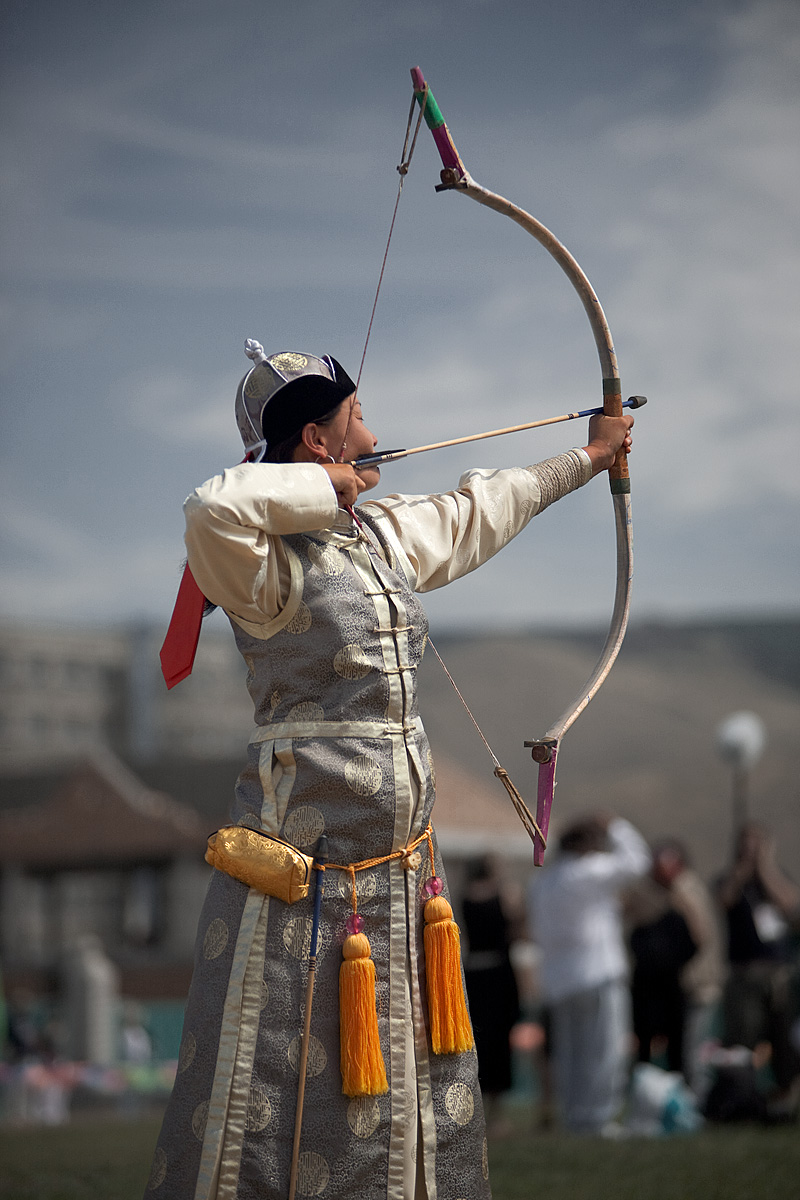
    Open castes are job types that are family-neutral. Anyone can choose to participate in these job fields, regardless of heritage. Common job types include labor jobs (such as mining) and military fields. All fields of military work (whether cavalry, archery, etc.) are open to all citizens, although some families take pride in having a specialty, like the Lu'khavi family, who are known for their archers.

    Prestigious castes are inclusive and require invitation by the masters of those castes to gain entry. These are often awarded during a child or teenager's schooling years to those who show promise. Prestige fields cover scholarly jobs, clergy jobs, artists, shamans, and others. Note: introduction into a Shaman caste relies on the child receiving 'the Calling' first, which is a naturally occurring incident that awakens their connection with the spirit realm. These jobs are considered to carry more honor and presence than locked or open jobs (excluding the military, where rank bears honor) and are highly sought after. Perhaps the most honorable of these Prestigious castes is induction into the Uramjen.

    The Hidden  castes are a those that aren't known by the public. I have only developed one thus far, and it isn't even known by the government.  Magicians/Magi fall under a 'hidden' caste that is known only by those at Heskegi University and Uramjen Fortress. They are protected from public and government knowledge because many harsh stigmas exist about Magicians in the world of Drumlore and those affected with those uncanny abilities are hunted down to either be captured and used or be killed outright.

    Note: There can be more of one of the same caste type distributed between families. For example, the Lu'khavi family raises battle rams and their stock are known for being the best breed in the land. However, they are not the only family to raise battle rams. Other families also have that caste type in their selection. If a child is born a Lu'khavi and wants to pursue ranching, however, he or she must learn and work for their own  family, not another family's ranchers.

Marriage

    Because of this system, bigger families equal a bigger workforce. In a way, your last name is not just your birthright, but your brand.  Making babies is, therefore, a pretty important part of life. 

    When it comes to marriage, a woman joins a man's last name, regardless of her family's prestige or what her caste is. There is a grade of sexism within At'mavi, unfortunately, which I do not condone either. Family-keeping is their priority caste once children are involved. Before children, and once the children grow into their mid to late teens, the mother works the caste she had chosen before marriage, but has the option of selecting one of her new family's castes instead.

That being said, a woman does not have to marry. If a woman is not married, they are treated equally as far as caste selection goes.

    When a man marries a man or a woman marries a woman, they continue to work within their family's castes separately. Their marriage ceremony, while still being considered marriage, is executed a bit differently and neither surname is changed. They become members of their families that are dedicated to the betterment of their castes and trade. Some of these couples choose to take care of orphaned children. In this unique situation, the child apprentices under the castes of both families and chooses their trade from both sets. 

Questions? Comments? Feedback?

    That is all for now. Please, feedback makes my day! You may inspire my next post with your questions or comments, whether it is here or on facebook! Til next time, live well, and read more! o7

Saturday, July 26, 2014

Zodiacs to Archons: God System Expansion

Drawing of God Jhordone, courtesy
of Logan, my cousin. 
     In this entry, I'll be getting the interested public up to date with the global religious system and the characters called the 'Archons.' Originally, there were only a few Gods. They were considered the 'big bad guys' of my world for various reasons. I've always preferred that all of a story's perspectives have a good and a bad side, however, and my Gods were no different. So, after years and years of dwelling on it, the first working religious system is going live for Drumlore. Here is what has changed:


Old Lore
New Lore

  • There were six Gods: Geovhentae, 
  • Rhom'hiidra (worldshifted into cousin's world), Jhordon, Yvidnon, Yheciel, Arkvunda (who came to replace Yheciel)
  • The Gods had no minions or non-human servants except for Geovhentae, who commanded beasts known as the Hounds.
  • Each God had one avatar in humanoid form, save Geovhentae, who had a council.
  • The Gods knew the truth behind their creation and lied to control the people.
  • There was believed to be nothing greater than the Gods.
  • N/A
  • Demons had nothing to do with the God system and there were no evil anti-gods, save Shaegon, who was just a fallen god.

  • There are Eight Gods: Geovhentae, Kurdah, Jhordone, Yvidnon, Probihan, Balki (Gorojin), Sas-Akra, and Arkvunda
  • The Gods have many servants and minions, most of which are non-human 'old world machinery.' 
  • Each God has one avatar, including Geovhentae.
  • The Gods are oblivious to their own creation and believe they created the world and all of its people.
  • There are four entities greater than the Gods.
  • Added twelve Archons, each with two avatars, male and female.
  • There is a mirror pantheon of anti-Gods that sit poised to undo all of creation.

Zodiacs to Archons

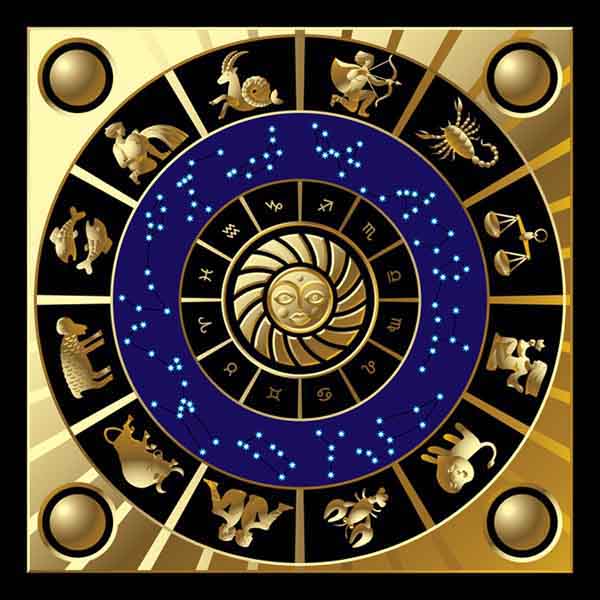
     By now, those who know me have probably also noticed that I'm a pretty avid student of the ways of the zodiac. I don't take it all on faith--some of it I still feel may be a bit psuedoscientific, like daily horoscopes--but I see undeniable evidence all around me on how birth date correlates with a repeating pattern of traits. A fictional world is the perfect breeding ground for great new takes on overplayed themes, so I've established an 'archon' system. These lesser gods, in a manner of speaking, represent the zodiacs and their traits.

For Aries, there is Harskael
For Taurus, there is Urwal.
For Gemini, there is Bismodus.
For Cancer, there is Sharmiil.
For Leo, there is Adinathi.
For Virgo, there is Groth.
For Libra, there is Eril.
For Scorpio, there is Rubalkai.
For Sagittarius, there is Jarn.
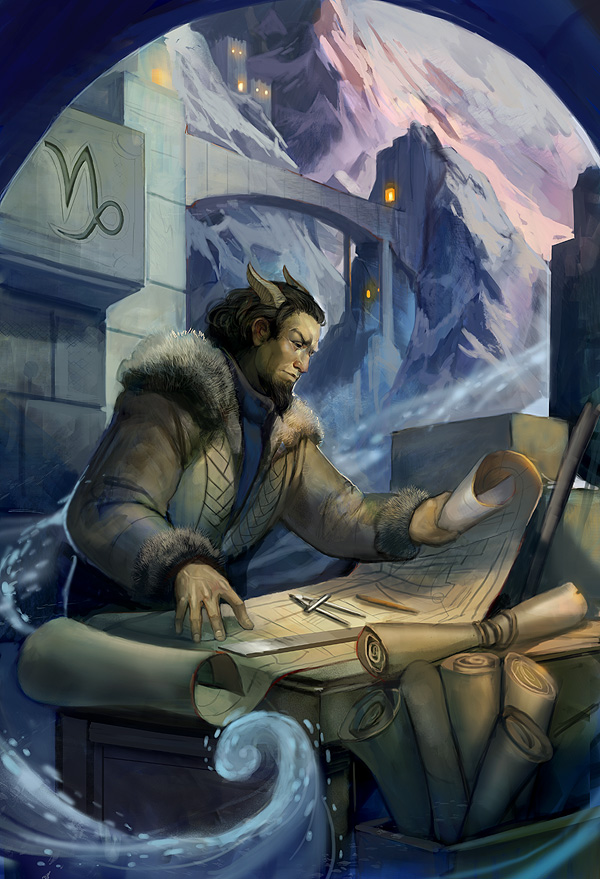
For Capricorn, there is Cern.
For Aquarius, there is Parkaresh.
For Pisces, there is Eudis.

     What do they do? These beings watch over mortal kind as silent giants. Like the Gods, they never interfere,  doing their work in ways that mortals supposedly cannot understand, such as the manipulations of dreams, fate, and allotted fortunes. Like the Gods, the Archons preside over different things and have avatars to speak on their behalf within mortal kind. Unlike the Gods, these twelve beings have two avatars--one for man and woman. These avatars, like the ones for the Gods, take on certain attributes that reminisce of the Archon they represent. 

Pictured left is the artwork of Julie Dillon, one of my favorite artists. Her take on the zodiacs in mortal form heavily inspire my Divine Avatars. CLICK HERE TO SEE MORE!

     There is also quite a story that goes along with these archons, which takes us to the creation mythology.

Creation Mythology

     So originally, the Gods that be kind of made the world and that was that. I didn't have much more to say about it, but I've upped my game. Explaining this section may help to explain the other sections of lore, such as what the Gods do and mean. So, let me get started.

First, there was one thing in existence. This one thing is called Thrum. Thrum is everything in one substance. Thrum is perfection. Thrum is all three prime substances of existence as one undivided thing (energy, matter, and concept/invisible law). Don't strain too hard, it's more than likely impossible to fully visualize or comprehend this with the human brain. This is also the end goal of alchemists in my world: to discover the Deimor Grothis, or primal recipe that can recreate the essence of Thrum. See: Prima Materia

From Thrum came the first emanation. This first emanation, called the shattering of Thrum by some doctrines, gave birth to the first three separate entities in existence: Energy, Matter, and Concept/the Invisible Law. For help understanding what I mean by Concept/the Invisible Law, one should study or relate to the Tao in Taoism or the Demiurge of Plato's philosophy. 

When the emanation echoed back, Thrum poured forth the second emanation. This gave form to the first four Gods: Kurdah, Jhordone, Yvidnon, and Geoventae, each a representation of the foundation of existence that they brought forth with them. Jhordone exists as the great embodiment of the air, Kurdah of earth, Yvidnon of water, and Geoventae of fire, radiance, and heat energies*.
* Other divisions of energy are also attributed to the Gods. Kinetic energy, or motion, is credited to Jhordone.


When the elemental emanation echoed back, Thrum poured forth the third emanation. This gave birth to the second tier of Gods: Arkvunda, Probihan, Sas-Akra, and Balki, each representing one of the four building blocks of life. Arkvunda exists as the weaver of flesh and bodily matter. Probihan exists as the creator of the spectrum of emotions. Sas-Akra exists as the founder of the mind and all mental faculties. Balki exists as the spinner of the spirit and soul. Together, these Gods are responsible for all sentient life.

The Gods then created the land and the greatest of animal and plant beings: humans and trees.

Thrum, hearing the echo of its shattered perfection, gave its fourth emanation. This created the twelve Divine Archons. These beings, tasked by the greater Gods,  took the rough new world and refined it and each of the building blocks used to create it. They worked synonymously and, often, together to weave the tapestry that is the known world. Note that each Archon also added to mortal kind myriad traits depending on which zodiac they represent. These, for simplicity, will not be mentioned.


What each Archon created in the beginning is still under heavy development. What is known for sure is that the process more or less began with Jarn (Sagittarius) and ended with Cern (Capricorn), and they all work together in between. The Archons will be responsible for decorating the earth, sculpting its mountains, valleys, rivers, etc, and distributing resources across the map. The most important contributions developed result from the hands of Parkareth and Cern

Cern required more variance within life to forge a working system that would sustain the world. Parkareth took the blueprints of life given to the earth by the Gods and made the rest of the planet's plant and animal species as well as the different races and ethnicities of mortal kind. Because Parkareth is an Archon, an emanation further away from perfection than the Gods of life, these beings are not as perfect as Man or Tree, but they served Cern's purpose. 

     With Parkareth's touch of variance, Cern created all of the planet's systems. This includes the ecosystems, weather systems, the water currents within the oceans, the flow of magma within the earth, the movement of the moon and sun, the tide, and, most importantly, the cycle of life, death, and time itself. Most consider Cern to be the hand of the Invisible Law itself, and therefore, the most powerful of the Archons. When the creating and planning was done, Cern set laws in motion and, as time and history began, the Gods and Archons rested and watched creation unfold.

What the Gods and Archons do Post-Creation

     They rest on their laurels, of course. After creation went live without a hitch, according to stories, they watched from afar, waiting for mortal kind to grow comfortable with the world they were in. Once deemed ready, the Gods and Archons selected those who would become their Divine Avatars.

     These avatars took on an appearance that somehow represented their deity. Through the avatars, the Gods spoke to the people and imparted their wisdom, assisting them as they came to understand art, architecture, government, history, etc. Then, they communicated to the scribes of the different lands the story of their creation so that it forever be kept as a sacred memory and a testament to the bond between mortal kind and the celestial forces.

    There is a divine scripture that exists throughout all denominations of this near-global religion.  All sectors follow it to the letter as truth. However, each Godly avatar has expanded upon the text to create doctrines followed only within their own denomination. Much like the Talmud of Judaism. 

     The Gods and Archons now roam the planet, staying out of the affairs of mortals. The Archons, in particular, are difficult to find. The Avatars convene to handle affairs together semiannually or in times of crisis. The Godly Avatars hold more authority than those of the Archons, but all voices are heard. When not convened at the Senate, the avatars roam the map freely, observing the affairs of mortal kind and handling situations where they emerge. The Archonic avatars handle menial  issues that are too far below the Godly avatars to handle, such as checking in on temple clergies to monitor their handling.


     Occasionally, the Gods appear and come to the aid of their lands when suffering natural disasters. Jhordone and Yvidnon are most notable. The God of air poises himself between his cities and incoming tornadoes, either destroying them or redirecting them over or around the city. Yvidnon, governing typically hot and dry regions, delivers waters to drought stricken regions within his great vessels. Plagues and diseases are occasionally cured by the weaver of flesh, Arkvunda. While scarcely making an appearance in the material world, Balki protects the spirit from invisible harm, thwarting demons, possessions, and other ailments of a spiritual nature.

Reincarnation Ideology: Rubalkai's Affirmation

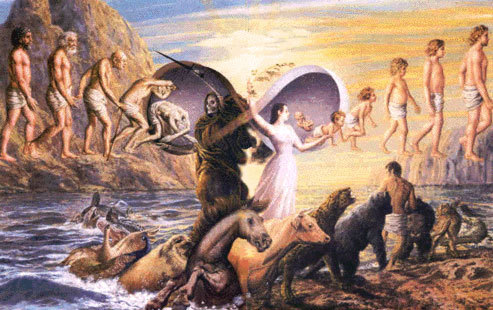
     Reincarnation is believed almost universally in various forms across the globe, whether it is religious or shamanic in nature. In religion, the concept was passed onto mortal kind by the avatar of Rubalkai (with the authority of the avatar of Balki) and is referred to by the name of Rubalkai's Affirmation. It goes roughly as follows:


  • All beings are to reincarnate into a new body post death.
  • There will be complete regeneration within new bodies; no memories will remain, only the soul.
  • The soul begins under the care of the first archon, Harskael, and follows a circuit, progressing through the spheres of the other archons' authority (aka, born under the next zodiac) until the process ends in the care of the last archon, Eudis.
  • The soul progresses through spheres by living: one must garner experience in life through facing the many challenges set by the archons presiding over them at the time. As they learn and adapt, from youth to death, they either further themselves toward freedom from the cycle or set themselves back.
  • If the soul reaches Eudis and is not judged refined enough to leave the cycle (also referred to as transcending the spire), the soul begins another cycle under the care of Harskael.
  • The soul must work through many cycles to become perfect in the eye of Eudis. This is the ultimate goal of all living souls.
     The journey through the cycles of rebirth is often pictured as a spiral minaret with many floors. At the bottom is the sun, at the top is the moon, at each side are the horns of Cern, and in the center is Rubalkai, depicted as a large solitary eye on a metal sun. Each cycle of Harskael to Eudis is pictured as a floor on the tower. At the top are stairs, a ladder, etc. that represents breaking free of the cycle, or transcending the spire.
     What happens after transcendence varies slightly per denomination, as do the rules governing cross-species reincarnation (troll to human, etc.) Which leads us to...

Racial Controversy

    Because the translations of the original doctrines vary due to language differences, disputes have arisen concerning certain elements. One of which is whether or not trolls, nokans, and humans are equal. Some translations specify that it was not man, but mortal kind that was made by the Gods of life, and that would encompass trolls, humans, and  the Nokanese people. Other translations hold trolls and nokans (as well as troll-human hybrids) to be of lesser divinity and sophistication than humans because they are a product of Parkareth adding variety to the world.


Ok guys I have put a loooot of stuff in this one blog post, so I'm going to give it a rest. Anything else will have to come in future installments.

Like, I know for sure that I'll be doing a post on the "anti-Gods" and "vortex of the dead" when I iron out the rest of the names and laws that go with them. That'll probably come up some time after this one.

I LOVE YOUR FEEDBACK. As a writer that's struggling to get going, it totally makes my day. Even if you only read the first sentence and then scrolled to the bottom! I'm okay with that!!!

In the works:
  • The anti-god system.
  • Divine literature and fables.
  • An article on Races.
  • Short Stories.
#fiction , #writing , #creativewriting , #fantasy , #fantasyfiction